Garden Frenzy (Board Game)

Overview
Genre: Strategic Card Game
Role: Lead Designer
Focus: Economy Design, Balancing, Project Management, Rapid Prototyping
Garden Frenzy is a competitive tabletop strategy game where players race to cultivate the most valuable garden while actively sabotaging their opponents. The core loop revolves around tight resource management: players must balance planting high-yield flora with purchasing physical defenses and "Action Cards" to disrupt rival boards.
As Lead Designer, I architected the complete ruleset, the in-game economy (Shop System), and the mathematical balancing of card rarities, drop rates, and point values.
The Core Economy & Synergy
-
Economy & Dynamic Shop System: Designed a rotating "Shop Phase." Players earn currency based on their garden's performance in the previous round (1st place receives 5 coins, last place receives 1). This creates an active "catch-up" mechanic while still rewarding optimal play.
-
Strategic Choice: Players must continuously decide whether to hoard cards for end-game points or sell them to the bank for currency to buy powerful Action Cards, adding a layer of economic strategy beyond just drawing from a deck.
-
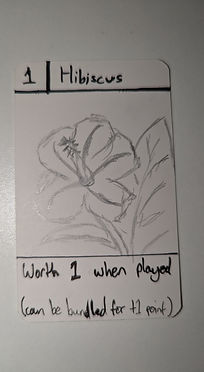
Synergy & Risk Management: Implemented a compounding point system. Common plants can be "bundled" for set bonuses, while Rare plants yield high base points but occupy valuable hand real estate.
-
Multipliers & Vulnerability: Decoration cards act as 2x score multipliers but are instantly destroyed if the host plant is sabotaged. This forces players to actively purchase and deploy Defense cards rather than just passively hoarding points.


Production, Rulesets & Problem Solving
Production & Asset Management:
Managed the physical component pipeline. Built and maintained a comprehensive, spreadsheet-based Asset Tracker to log the status, balancing math, and artwork completion for every Plant, Sabotage, and Decoration card, ensuring cross-discipline alignment.
Critical UX & Problem Solving:
The "Runaway Leader" Snowball Effect:
-
The Challenge: Early playtests revealed a critical flaw in the economy: players who won the first round had too much purchasing power in the Shop Phase, allowing them to buy all the Sabotage cards and continuously suppress the losing players, creating a frustrating "snowball" effect.
-
The Solution: I restructured the turn order and currency injection. The player who scores the lowest in the previous round is given first priority in the Shop Phase. Even though they have fewer coins, giving them the first choice to buy cheap, high-impact Action cards mathematically broke the runaway leader loop and kept games highly competitive until the final round.


Post-Mortem & Psychological Design
Spreadsheet Balancing vs. Human Psychology:
Critically analyzing the development process, my initial balancing pass relied entirely on spreadsheet mathematics (calculating the exact coin-to-point value ratio of every card). While mathematically sound, live playtests proved that "psychological value" often overrides pure math in a physical game. For example, players frequently hoarded "Sabotage" cards not because it was mathematically optimal for their score, but because the psychological satisfaction of ruining a friend's garden was highly engaging, completely skewing the expected economy.
The Takeaway:
Tabletop and systems design requires balancing for human emotion, not just numbers. In future prototypes, I will transition from spreadsheet theory to "blind playtesting" (watching players play without explaining the rules to them) much earlier in the pipeline to observe how real human spite, alliances, and psychology warp the intended mathematical economy.


