Custom VR Peripherals & Project Flicker
Overview
Engine: Unreal Engine 5
Role: Technical / Level Designer
Focus: Systemic Design, VR Optimization Pipeline, Physical-to-Digital UX
This massive, multi-disciplinary Level 6 group project featured two core deliverables: Project Flicker (a high-fidelity VR psychological horror experience) and Panic on the Polaris (an asymmetrical co-op game integrating a custom physical hardware prop with an Unreal Engine 5 digital environment). Operating as the central design and pipeline pillar for a thirteen-person team, my objective was to translate our creative vision into an optimized reality, establishing strict technical methodologies to prevent cross-department bottlenecks.
The Pipeline & Documentation
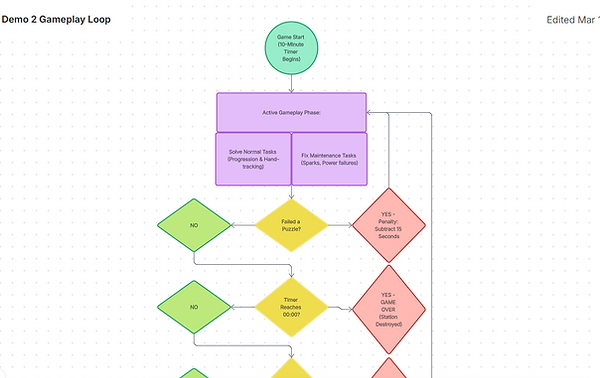
Before opening the engine, I architected the project's macro-structure using Confluence. I authored strict UI flowcharts, mathematical puzzle rulesets, and hardware topology maps. This established a definitive source of truth, ensuring the engineering and art teams understood exact dependencies and mechanic constraints from day one.
On a personal level, while my early investment in Confluence successfully democratized project knowledge, I over-indexed on administrative infrastructure during the initial weeks. This delayed my own transition into engine implementation. I spent time organizing tasks that could have been spent actively white-boxing environments earlier in the schedule.
-
The Takeaway: While systemic documentation is crucial, technical design is ultimately proven in the engine. Moving forward, I will implement a strict "Timebox" rule for documentation phases, ensuring I transition from wiki-building to functional engine prototyping much earlier in the production cycle to rapidly test the viability of my own design theories.

Remote Level Design
Live Spatial Validation:
For Panic on the Polaris, I rejected the traditional isolated design phase. Instead, I facilitated live, remote blockout sessions over Discord. Utilizing Unreal Engine's basic primitives, I constructed the control room greybox in real-time with the art team. We systematically locked in scale, sightlines, and VR ergonomics, immediately providing the programmers with a collision-ready, functionally validated spatial sandbox.
The Waterfall Dependency Trap:
Critically analysing our macro-pipeline, the team's most significant friction point was falling into a waterfall dependency structure. Because Project Flicker required a massive thematic pivot midway through development, early art production was severely delayed. This created a downstream bottleneck where programmers were left waiting on submittable assets before they could build core logic, forcing a heavy development crunch in the final weeks.
-
The Takeaway: Future multi-disciplinary projects require a ruthless enforcement of an Agile "Greybox-First" methodology. By ensuring engineering teams are building logic on primitive geometry immediately, art and code can iterate parallel to each other, completely eliminating the waterfall crunch.

Acoustic Engineering & Problem Solving
For Project Flicker, I implemented localized 3D spatial audio, tuning specific attenuation spheres and pitch variances to organically guide the player without unnatural audio bleed. For Polaris, I defined the network state logic, strategically categorizing physical hardware interactions into synced versus un-synced data streams. By syncing only binary states, we drastically reduced the network payload, guaranteeing zero latency for the asymmetrical puzzle mechanics.
When evaluating the project's mixed-reality constraints, I identified two massive engineering risks: the coding overhead for mixed-reality recalibration, and the bandwidth cost of a custom VoIP system for the physical LAN setup.
To solve communication, I engineered the "Vocal Pocket," applying specific EQ dips to the mid-range frequencies of the in-game alarms. This acoustic carve-out allowed players to shout instructions across the physical room naturally, removing the need for a programmed VoIP solution while maintaining unbroken immersion.


VR Optimization & Final Polish
VR Optimization Pipeline:
Meta Quest hardware demands strict VRAM discipline. I engineered and enforced a rigorous asset optimization pipeline. Instead of relying entirely on external 3D software round-trips, I utilized UE5’s Modelling Mode to perform localized mesh surgery, correct broken pivot points, and resolve coplanar Z-fighting. I audited our memory footprint, implementing a universal 1K texture limit across all environmental materials and enforcing strict poly-count caps on hero props to guarantee a stable stereoscopic framerate.
Rather than forcing complex digital solutions, I executed critical UX trade-offs. I designed the "Analog Loophole"—a physical UX flow where players simply swapped seats in the real world to recalibrate the asymmetrical state, entirely eliminating the need for complex mixed-reality tracking code.

